


The biceps is a main arm muscle and one of the medical manifestations of this area is biceps tendonitis. In this post we tell you what its symptoms are, its causes and how to help prevent the appearance of biceps tendinopathy.
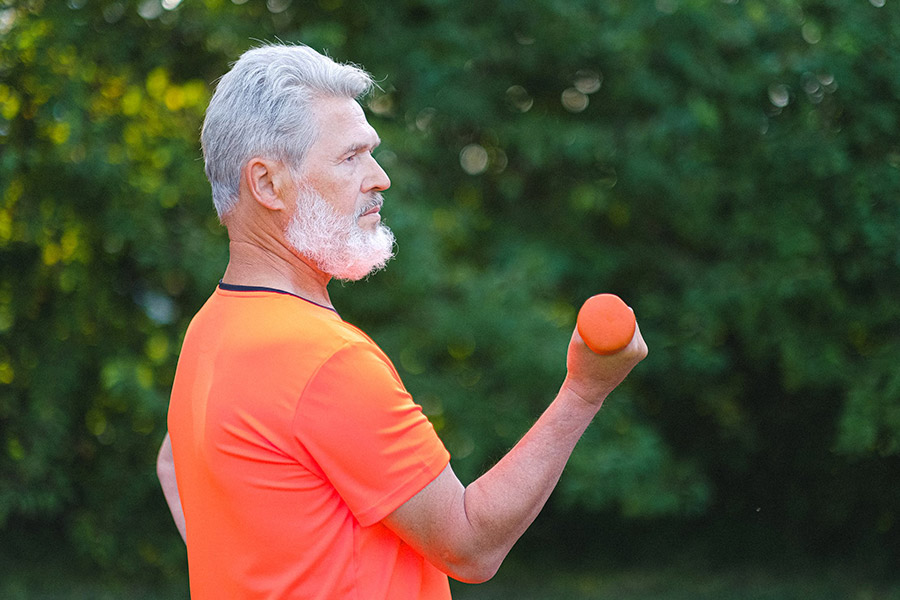
What is the biceps?
The biceps is a muscle that runs from the shoulder blade to the top of the radius. It is located close to the coracobrachialis and brachialis anterior muscles and is a muscle of the anterior region of the arm. It is also known as the biceps brachii, as it is a superficial muscle with two heads.
Biceps composition
The muscle is made up of two heads. The long head of the biceps It is a tendon that inserts into the supraglenoid tuberosity of the scapula (shoulder blade) and runs along the inner surface of the humerus.
The short head of the biceps It originates from the coracoid process of the scapula, also called the scapula.
Both heads join to form a flattened tendon that follows the same path to reach the bicipital tuberosity of the radius.
Biceps function
The biceps, like other muscles in the body, such as the hamstrings, is a biarticular muscle. This means that they cross two joints, in this case the elbow and the shoulder.
The functions of the biceps are several. First of all, The biceps is the muscle that is responsible for supination of the forearm., that is, when the elbow is fully stretched, this muscle is responsible for rotating the forearm for supination. Besides, The biceps is the main muscle that acts to flex the elbow. With the elbow fixed, it acts on the shoulder girdle
On the other hand, the biceps helps the shoulder perform its functions of stabilization, anterior flexion, abduction and external rotation.

What is biceps tendonitis?
It is the most common injury to this muscle. The biceps tendonitis It is an inflammation of the tendon of the long head of the biceps. and generally, it is usually related to a rotator cuff injury in the shoulder.
Symptoms of biceps tendinopathy
Patients with biceps tendinitis present the following symptoms. First of all, they state pain in the anterior aspect of the shoulder, as well as a limitation of its mobility.
On the other hand, patients with biceps tendinitis show bruises in the elbow flexion area and tenderness in the upper arm.
The pain usually begins mildly and worsens with use of the arm and shoulder. In case of biceps tendon rupture, patients present more intense pain that extends from the proximal region of the arm to the elbow, so it is important to go to elbow trauma specialists so that the symptoms do not worsen and do not lead to this tendon rupture.
Types of biceps tendonitis
As previously mentioned, we already know that the biceps is a muscle that includes the shoulder and elbow joints. Therefore, there are two types of biceps tendinitis.
On the one hand, the proximal biceps tendonitis It occurs when the tendons that connect the upper part of the biceps to the shoulder inflate. Patients with this type of injury experience pain in the upper arm and shoulder.
Instead, a distal biceps tendonitis It is one that appears when the tendon that joins the lower part of the biceps to the elbow, so its symptoms are associated with pain in the elbow area.
This tendinopathy is also known as climber's elbow, the injury that affects climbers due to the hyperextension they perform of the elbow on the climb.

Causes of biceps tendonitis or bicipital tendinitis
Biceps tendinopathy can be caused by different reasons. In general terms, it is associated by a biceps overload due to excessive training and abuse of the biceps tendon. Sudden changes in biceps tendon training intensity have a considerable influence.
Likewise, lifestyle and routine tasks can influence the appearance of biceps tendonitis, so performing repetitive movements can be a cause of this pathology.
Degeneration of the bicipital tendon accompanied by excessive use of the rotator cuff It is another cause of biceps tendinopathy.
How to differentiate biceps tendinitis from other shoulder injuries?
Shoulder pain can have many causes, such as bursitis, a rotator cuff tear, or even a labral tear. In biceps tendinitis, the pain is mainly located in the front of the shoulder and can radiate down the arm, increasing when lifting objects or turning the palm upward.
In contrast, with a rotator cuff tear, the patient typically experiences weakness and difficulty fully raising the arm, while with bursitis, the pain is more diffuse and usually accompanied by visible swelling. Clinical examination and imaging tests, such as ultrasound or MRI, allow for precise identification of the source of the pain and determination of the most appropriate treatment.
Risk factors when suffering from biceps tendinitis
An injury caused to the biceps tendons may present some risk in patients with certain diseases.
People with diabetes are at increased risk of having diseases related to muscles and joints. These patients feel a lot of pain in the affected joint and muscle fatigue.
The factor of Age is another factor in the appearance of biceps tendonitis.. As people age, tendons lose elasticity, which leads to greater vulnerability to biceps tendinopathy injuries.
All those people who perform repeated movements, whether due to tasks at work or athletes who overload the biceps muscle, are at risk of developing repetitive strain injuries, what is this pathology like?
The rheumatoid arthritis of shoulder It causes inflammation of this joint and can become progressively worse with exercise and movement. Similarly to this disease, Patients with psoriatic arthritis are a risk factor for tendinitis.
Diagnosis and treatment of biceps tendinitis
For any patient who presents these symptoms mentioned above, it is recommended to go to shoulder and elbow specialists so that they can diagnose the case and offer you the most appropriate solution to alleviate the pain in the biceps tendon.
The Elgeadi Traumatology team can make a diagnosis through arthroscopic surgery, one of the most innovative minimally invasive techniques that allows access with a small incision and a complete view of the pathology of the biceps.

Tips for Treating Biceps Tendon Injuries
Some of the recommendations for the treatment of biceps tendonitis are to perform a series of exercises and stretches at home, in addition to applying cold to the affected area to control its inflammation and improve symptoms.
Mainly, it is important that the patient rest and prevent the tendon from further inflammation. Therefore, it will be necessary to moderate the training load in some way and change the exercise routine in some way. Patients with should perform exercises and stretches to strengthen the biceps with biceps tendonitis.
If you suffer from biceps tendinitis, heavy loads should be avoided, as well as forced movements of the shoulder, especially above the head.
When to see a specialist for bicep or shoulder pain
If you experience bicep or shoulder pain, it's important to consult an orthopedist if the pain persists for more than a week, appears after strenuous activity, or prevents you from moving your arm normally. Other signs to watch for include bruising, clicking or popping sounds when moving your shoulder, or a visible deformity in your arm, which may indicate a partial or complete tendon rupture.
Early diagnosis is key to preventing inflammation from becoming chronic or leading to a complete rupture.
Recommended exercises to strengthen the biceps tendon
Strengthening exercises are essential for improving muscle function and preventing future tendinopathies. In the early stages, isometric exercises are recommended, which activate the biceps without generating movement in the joint. These help maintain strength and prevent muscle atrophy while controlling inflammation.
Next, mobility and stretching exercises are added to improve tendon flexibility and relieve shoulder stiffness. Gentle rotational movements and low-resistance band exercises are helpful for strengthening the arm muscles and rotator cuff.
In addition, working on body posture and scapular stability reduces stress on the biceps tendon, leading to a faster and safer recovery.
How long does recovery from biceps tendinitis take?
The recovery time for biceps tendinitis depends on the degree of inflammation and the type of treatment applied. In mild cases, symptoms usually improve within four to six weeks with rest, physical therapy, and specific strengthening exercises.
Especially when there is a rotator cuff disorder or tendon degeneration, the process can take up to three months.
During this recovery period, relative rest is essential. The patient should avoid repetitive movements or overhead exertion, as well as any activity that causes pain. As the inflammation subsides, progressive exercises are incorporated to regain strength and stability in the shoulder.
The return to sports activities or work tasks should always be done under medical or physiotherapy supervision to avoid relapses of the injury.
The treatment and prevention of biceps tendinitis should be carried out with great professionals who are experts in traumatology so that they can evaluate the case and carry out an appropriate diagnosis and treatment, which can help you progress and move forward. At Elgeadi Traumatology, we have been in the profession for more than 10 years, applying the most innovative techniques in arthroscopic surgery. Make an appointment with our shoulder and elbow specialist traumatologists and your elbow recovery begins.


42 thoughts on “¿Qué es la tendinitis del bíceps? Causas y tratamientos”
Hello, good evening, I have proximal biceps tendonitis.
Good morning angel,
In that case, we recommend you go to our trauma clinic, where we can offer you the treatment that best suits your pathology.
All the best!
Hello, good night, proximal tendonitis can spread throughout the body.
Good morning Esteban,
Thanks for your comment.
Regarding your question, no.
All the best.
How to differentiate between distal tendinitis or bicipitorradial bursitis?
Hello Alfonso,
Clinical examination is the best diagnostic tool. Although we can support you with Rx and MRI studies.
Luck!
Hello
A scoliosis at the level of T2-T4, due to spinal rectification, could cause elbow pathology...
There is pain at the epicondyle and epitrochlear level by pronating the clamp and lifting the minimum weight with the elbow stretched on the epicondyle.
In elbow extension and flexion there is pain in the epicondyle and in the distal bicipital and trochlear tendons.
It comes from a frozen shoulder that coincided 10 years ago with scoliosis and coexisted with the frozen contralateral shoulder.
I appreciate your response in advance.
Hello Sergio,
A priori, scoliosis is not related to epicondylitis.
All the best.
Hello, can tendinitis cause weakness in the Romanian and fingers?
Hello Clara, yes, but to see if that is what is causing the weakness you will need to go to a professional to perform a physical examination.
You can make an appointment with one of our professionals by calling 910 053 900
Greetings!
Hello, I have bipseral tendinitis. These days it hurts like a sting in my ear. Is this related?
Good afternoon,
We cannot know if it is related without doing a series of medical tests to corroborate it.
Greetings
Hello, I hope you are well.
How long can bicep tendonitis last?
Hello Maria,
It can last from about 6 weeks to a few months. It all depends on the rest and stretching exercises you do.
Greetings
Greetings. I wanted to ask if this is related to epicondylitis. Thank you very much in advance.
Hello Reme,
Epicondylitis and biceps tendonitis are inflammatory conditions that affect the tendons. Epicondylitis, commonly known as “tennis elbow,” affects the tendons in the elbow, while biceps tendonitis affects the tendon that connects the biceps to the shoulder.
Greetings
It is possible for a tendon that is almost completely torn but not completely. It can regenerate with therapy and exercises and rest. Or only surgery can repair it. And the times of both cases, thank you very much and very helpful.
Hello Willy,
We would have to see your case to know if surgery is necessary.
You can make an appointment by calling 91 005 39 00.
Greetings
Hello, I broke the head of my humerus in 3 places with displacement, 3 months ago, and my shoulder doesn't hurt but my biceps hurt quite a bit. Could it be tendonitis?
Hello Susana,
With that background, it would be best to review it in consultation.
You can make an appointment at our center by calling +34 91 005 39 00.
Greetings
Hello Dr.
I had surgery for a torn left rotator cuff over a year ago (with an implant or anchor), in December 2023) three months into the rehabilitation period I began to feel discomfort and pain in the biceps tendon at the proximal (shoulder) and distal (elbow) level, to which they told me it was because the operation was very recent, in January 2025 they infiltrated me without any improvement for which I infiltrated again in March, but to date April 2025 it still hurts and I have discomfort (crunching), and limitation in internal rotation, I have had pharmacological treatment for the pain, I have put ice on it but I do not want to infiltrate more, because according to what they have told me that so many infiltrations are counterproductive.
What would be the possible tests and diagnosis, doctor, since it's something that limits me and causes me a lot of pain? Thank you so much for your attention. 😊
Hello Wilintoon,
In cases like yours, where biceps tendon pain persists after rotator cuff surgery, a complete clinical evaluation accompanied by imaging tests is recommended. Among the studies that may be ordered are musculoskeletal ultrasound, magnetic resonance imaging (MRI), and functional studies.
Biceps tendon pain can be related to tendinopathy, persistent inflammation, a partial tear, or even mechanical entrapment if there's friction with adjacent structures. The cracking sound you mentioned could also indicate a disturbance in the tendon's gliding.
At this point, the most important thing would be to conduct a more in-depth diagnostic study to determine an appropriate and safe treatment.
Greetings.
Supraspinatus tendinosis
Biceps tenosynovitis
Hello Alexis,
Thank you for your comment. If you're experiencing discomfort related to supraspinatus tendinosis or biceps tenosynovitis, don't hesitate to contact us. We'd be happy to help.
Greetings.
Hello Dr.
I had tendinitis in the biceps tendon and supposedly at the same time a micro-tear of the supraspinatus, the latter no longer causes me discomfort but when I touch the area of the proximal biceps tendon (shoulder) I still notice discomfort, and I have been stopped for 3 months and having already treated physiotherapy, also when lifting weights I notice discomfort in that shoulder in that part, specifically in the frontal part, it does not prevent me from exercising but I notice discomfort that I do not even notice in the other shoulder, this happens to me with little weight too. According to an ultrasound from 1 month ago, there is nothing there, at rest it does not bother me but when I lift weights I already feel something there again.
Hello Lewis,
Thank you for sharing your experience. Even if the ultrasound shows no abnormalities, there may be residual inflammation or some tenderness in the biceps tendon, especially if the discomfort occurs when lifting weights. Occasionally, this type of discomfort can last beyond the usual recovery time, especially in areas like the shoulder, which are subject to a lot of stress.
Each injury is unique, and based on what you've mentioned, it would be advisable to have your case thoroughly evaluated by a shoulder trauma specialist to rule out any mechanical dysfunction, adhesions, or compensatory overload. It may be necessary to adjust your exercise plan or consider complementary treatments.
If you're in Madrid, you can schedule an appointment with one of our specialists by calling 91 005 39 00. We'll be happy to help you.
Greetings.
Good morning, I have biceps tendonitis. I have to stop going to the gym completely. Could I work on my legs and back, and only stop working on my arms so I can recover?
Thank you
Hi Milena, with biceps tendinitis, it's best to temporarily avoid exercises that cause pain and overload the tendon (heavy pulls, chin-ups, curls). You can continue leg and core exercises; back/chest exercises only if they are pain-free and use moderate weights.
Good morning, I have chronic ciceps tendinitis. I've already had therapy and injections, but the pain persists and is getting stronger. I've had pain in my right wrist for six months without any improvement from therapy or pain relief. What should I do in this case?
Good morning Diana. If after 6 months of wrist pain there is no improvement with physiotherapy or injections, a re-evaluation by an orthopedic surgeon with examination and imaging (ultrasound/MRI) is important to confirm the diagnosis and establish a definitive treatment plan.
Good afternoon
I've had shoulder pain for a year, especially when doing shoulder and chest exercises at the gym. I had an MRI of my left shoulder and it showed a strain in the long tendon of the biceps, with its sheath stretched along its entire length. I rested and did physical therapy for about 10 weeks and the pain didn't go away. Would I need surgery for this?
Thank you.
Greetings.
Good afternoon, Jaime. With biceps sheath strain/tenosynovitis and persistent pain after 10 weeks, surgery isn't always necessary: first, the exact cause is confirmed and the treatment adjusted accordingly. Surgery is only considered if there is an associated injury and conservative management has failed. Best regards.
Good afternoon
I just had an MRI and the results show the following: the long head of the biceps tendon appears to be of appropriate caliber and course, showing distension of its sheath along its entire length. I've had pain in the front of my shoulder for over a year, especially when doing chest and shoulder exercises at the gym. I rested and did physical therapy for about 10 weeks, but the pain persisted. What's the best course of action?
Good afternoon again, Jaime. With anterior shoulder pain lasting over a year and a biceps sheath strain, the most advisable course of action is a specialist evaluation to adjust the treatment: modification of gym loads, specific rehabilitation, and, if necessary, guided treatment (injection/ultrasound); surgery only if that fails.
Bonjour
Here is the result of my MRI
Tenosynovite fissuraire du long biceps sur 2cm / rupture des fibers supérieurs du muscle subscapulaire avec remaniement dégénératif / tendinopathie du supra épineux
The Strasbourg chirurgien proposes tenodese du long biceps avec vis d'interférence
There is a chance for me to sort out without chirurgie the part of mechanical instability that will last and irritate the long biceps that will cause damage after subluxation.
Bonjour. Avec une fissure du long biceps, une lésion du subscapulaire et une tendinopathie du supra-épineux, la prize en charge conservatrice peut aider, mais en cas d'instabilité/subluxations et douleur persistante, la tenodèse est souvent l'option la most reliable pour stabiliser et soulager.
Hello, can biceps tendinitis be related to rheumatoid arthritis? If so, can it be treated and relieved? Thank you.
Hi Mariela. Yes, rheumatoid arthritis can cause tendon inflammation (tenosynovitis), including in the biceps. It can be treated and relieved by combining rheumatoid arthritis management with local measures (relative rest, physical therapy, pain relief, and, if necessary, injections).
Hello, at the point where the biceps inserts into the elbow of both arms, I notice swelling and strong itching, especially at night.
Is it tendinitis or is there another cause?
Thank you so much
Hi Gladys. Intense itching and swelling in both elbows, especially at night, isn't typical of tendinitis; it's more likely due to a skin condition, allergies, or irritation. If there's also pain when moving or lifting, a medical evaluation is recommended to differentiate and treat it correctly.
Good morning, I have proximal tendinitis in the biceps of my left arm. My question is, is it possible that the tendinitis could be causing pain behind my shoulder blade? Thank you, I look forward to your response.
Good morning, Narciso. Yes, proximal biceps tendinitis can cause referred pain to the front of the shoulder and, sometimes, to the scapula due to muscle compensation. It's advisable to assess the shoulder and scapula to adjust the treatment and rehabilitation plan.