


CAM and pincer lesions are deformities that develop in the hip bones and can cause unusual contact during movement. Recognizing their symptoms and understanding what is happening to the joint allows for determining if femoroacetabular impingement is present and choosing the most appropriate treatment for each patient.

What are CAM and Pincer injuries of the hip?
CAM and Pincer lesions are bone abnormalities that develop in the hip joint, causing abnormal contact between the bones, called femoroacetabular impingement or CFA. This friction not only causes pain but also wears down the tissues.
You should know that having a CAM or Pincer does not always mean that you will feel pain or need treatment. Its relevance will depend on the symptoms and the clinical assessment, as indicated by the Oxford consensus on CAM morphology.
What is the difference between a CAM injury and a Pincer injury?
The main difference is that a pincer injury affects the hip socket, while a CAM injury directly affects the femur. Likewise, both are part of the femoroacetabular impingement or shock.
Why can CAM and Pincer injuries cause femoroacetabular impingement?
CAM and Pincer lesions are responsible for generating femoroacetabular impingement because by altering the bone anatomy of the hip, they generate abnormal contact in the area and, therefore, excessive friction between the femur and the pelvis that can generate pain and wear during movement.
The pressure generated by repetition can damage the cartilage and the labrum, which is the ring surrounding the socket, as explained by the American Academy of Orthopaedic Surgeons.
What symptoms do CAM and Pincer hip injuries produce?
When CAM and Pincer injuries cause impingement, the following symptoms appear:
- Deep groin pain: discomfort is generated in the groin that intensifies with twists or sudden movements.
- Pain around the hip: discomfort that extends to the front of the thigh or buttock.
- Joint stiffness: difficulty flexing or turning the leg inwards.
- Postural pain: discomfort is generated when sitting, bending over, crossing the legs or even putting on shoes.
- Clicking or locking: a strange sensation of joint catching, may be related to a labral injury.
- Limping: changes are made in walking to avoid pain when putting weight on the leg.
Why do CAM and Pincer injuries cause groin pain when moving?
CAM and Pincer lesions cause groin pain when moving because, when flexing or rotating the hip, this abnormal movement is generated in the area, irritating or damaging structures such as the labrum and causing pain especially when bending down or changing direction.
Which sports are most frequently associated with hip impingement?
Spinning and contact sports, such as football, hockey, and rugby, are prone to hip impingement. because they combine changes of direction and repeated flexions. Intense practice of these types of sports during growth is especially associated with CAM morphology.
Disciplines requiring high flexibility, such as ballet, gymnastics, and martial arts, demand wide movements that can promote contact between hip structures and trigger discomfort associated with CAM and Pincer.
On the other hand, racket sports, such as tennis and padel, involve twisting on the supporting leg, generating abnormal movements and increasing the risk of this type of injury. Cycling and running can also trigger symptoms in predisposed individuals, without necessarily causing bone changes.

When should hip pain in athletes be evaluated by an orthopedist?
It is necessary to consult with an orthopedist when the pain recurs during training, forces changes in movements due to discomfort, or limits daily activities beyond reducing the training load.
The hip unit at Elgeadi Clinic It helps to accurately assess these discomforts and determine whether they originate from the joint or nearby structures, guiding appropriate treatment.
How are CAM and Pincer injuries diagnosed?
The diagnosis of CAM and Pincer lesions combines a history of symptoms, a physical examination, and imaging tests. It is established that an X-ray showing CAM or Pincer changes is not sufficient to diagnose femoroacetabular impingement syndrome, as indicated by the Warwick Agreement which establishes that compatible symptoms, clinical signs, and imaging findings must coexist.
What physical examination helps detect a hip impingement?
The most important and accurate physical examination test to detect femoroacetabular impingement is the FADIR Test. This maneuver seeks to reproduce the pinching of the joint to assess whether it triggers that characteristic pain in the patient.
A complete physical examination usually includes additional tests such as X-rays and MRIs, depending on the case.
What imaging tests confirm a CAM or Pincer lesion?
When examining a CAM or Pincer injury, X-rays allow for the study of the shape of the femur and the acetabular coverage. When it is necessary to specifically assess the labrum, cartilage, or other possible causes of pain, the hip MRI It provides additional information, giving even more precise data. The specialist will indicate the tests to be performed based on the findings and the needs of each case.

What treatments are available for CAM and Pincer lesions?
The treatment for CAM and Pincer is divided into two progressive approaches: the conservative approach, that is, the non-surgical treatment, and the surgical treatment.
Conservative treatment aims to reduce pain and restore function, This includes activity adjustments, therapeutic exercise, and prescribed medication. Surgery, on the other hand, is considered in specific cases, taking into account the progression and condition of the joint.
When does conservative treatment work for hip impingement?
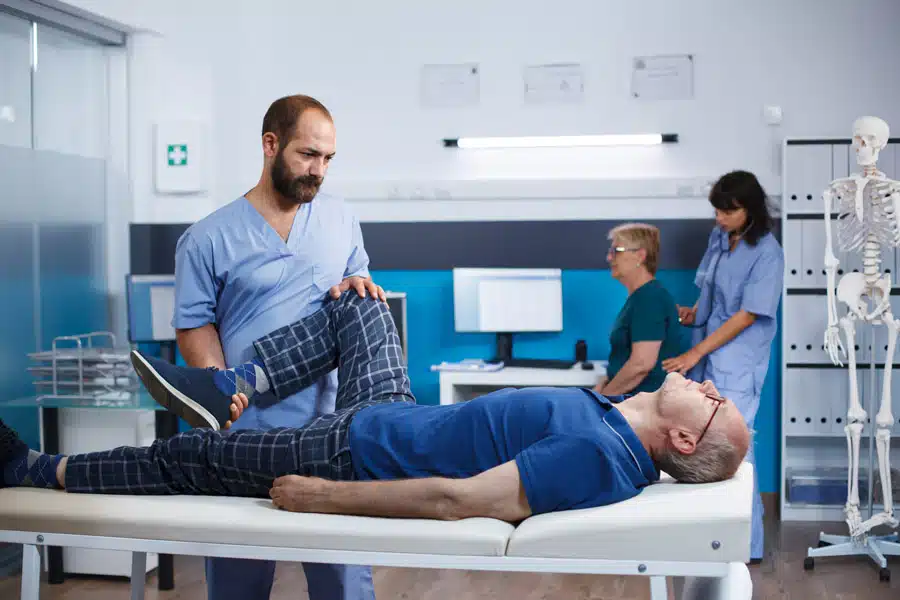
In cases of hip impingement, adjusting the load and following an individualized rehabilitation program may be sufficient. By working on strength, movement control, and tolerated mobility, painful positions can be avoided through physical therapy. This can improve symptoms, although it does not alter bone structure.
pinzamiento-cadera-tratamiento-ejercicio-terapeutico-05.jpg
When is hip arthroscopy recommended for CAM and Pincer lesions?
Arthroscopy is considered if limiting symptoms persist despite starting conservative treatment and there are reasons that justify intervention.
The hip arthroscopy It allows for the correction of bony prominences and the treatment of labral tears in specific patients. This treatment should always be determined by the attending physician.
What is it like to return to sports after treating a femoroacetabular impingement?
The return to sport after a femoroacetabular impingement is gradual and depends on the treatment performed, the strength that has been recovered, and the tolerance to sports movements. The return to sport should not be decided solely on the time elapsed but on the progress of rehabilitation.
After arthroscopy, recovery can take several months. If discomfort persists and interferes with activity, you can Request an evaluation at Clínica Elgeadi to receive guidance on the most appropriate treatment and recovery for your case.


