Spinal surgery as a treatment for canal stenosis caused by a herniated disc

Back pain is a common complaint that affects us all at some point in our lives. It can appear as a minor discomfort or develop into a sharp pain that limits our ability to perform normal movements. In more severe cases, the pain can significantly interfere with daily activities, making even simple tasks complicated and annoying. Although we generally associate these pains with intense physical efforts, it is important to know that an injury can occur suddenly, even by bending the back incorrectly or remaining in a bad posture for long periods. Therefore, if you experience pain, it is important to go to doctors specializing in the spine who can determine the origin of the pain and whether treatment is necessary.

What is canal stenosis and how is it diagnosed?

When we talk about canal stenosis we are referring to the narrowing of the spinal canal, the space through which the spinal cord and neurological tissue pass. This narrowing causes pressure on the nervous tissues, which can cause pain, tingling or weakness in the extremities. Although in most cases this narrowing of the canal is a consequence of a degeneration of the adjacent tissue, which is a fairly common pathology in people over 50 years of age, it can also occur due to an accident or a blow of traumatic origin. If you experience pain or discomfort after walking for a while or even tingling in the legs, arms, hands, it is important that you go to a doctor to perform a study and the necessary tests for a correct diagnosis. Generally, these tests consist of a prior assessment of the symptoms presented by the patient, supplemented with an X-ray. In many cases, a radiograph is also required. MRI mainly if you suffer from a herniated disc osteoarthritis, herniated discs, and other spinal pathologies

Osteoarthritis, herniated discs and other causes of spinal canal stenosis

As we have mentioned previously, in most cases the cause of spinal canal stenosis is due to changes by wear and tear on the spine, mainly related to osteoarthritis. Although it is also very common for this problem to be due to a herniated disc that puts pressure on this neurological tissue housed inside the vertebrae. According to the head of the Spine Surgery Unit at HM Universitario Montepríncipe, approximately 80% of the population will suffer from herniated disc or low back pain throughout their lives. This data reflects the progressive increase in these conditions in recent years. Other less common causes of spinal stenosis include congenital malformations, traumatic injuries, infections or tumors affecting the spine. Although these conditions are less frequent, they can also cause narrowing of the spinal canal, leading to the same debilitating symptoms as osteoarthritis or herniated discs.

Symptoms of spinal canal stenosis

Symptoms of spinal stenosis can vary depending on the severity of the condition and the location of the narrowing in the spine. The most common ones include:
  • Lower back or neck pain: Depending on the affected region, patients may experience pain in the lower back (lumbago) or neck (cervicalgia).
  • Tingling or weakness in the extremities: Pressure on nerves can cause feelings of numbness or weakness in the legs, arms, hands, or feet.
  • Difficulty walking: As the stenosis progresses, some patients experience pain when walking.
  • Loss of balance: In severe cases, stenosis can affect coordination and balance, increasing the risk of falls.

Treatments for canal stenosis

Although in many cases surgery is the best option for the patient, initial treatment usually involves rehabilitation techniques and orthopedic treatments such as electrotherapy, mesotherapy and kinesiotherapy. All of this is supported by the use of drugs to relieve the patient's pain and symptoms. When we talk about cases in which the patient suffers from greater pain, drugs are used more aggressive treatments such as radiofrequency or lumbar arthrodesis.

Lumbar disc herniation operation using advanced spinal endoscopy

Endoscopic disc herniation surgery is a Minimally invasive technique that allows for the precise removal of herniated discs, relieving pressure on the spinal cord and nerves that can cause pathologies such as spinal canal stenosis. This procedure guarantees a safe, rapid intervention with fewer complications. Below we will describe the key steps of this surgical process.
1 - Guide needle to mark the canal and insert the dilator

First, a guide needle is inserted and inside it a dilator that allows us not to damage any neurological, muscular or bone tissue and to directly access the area in which we are going to work through this cannula.

2 - We locate the level and our work area on the vertebra

After locating the level we check the correct visualization of the disc. We already have our work channel well positioned.

Vaporizer for cauterizing the area with radiofrequency laser

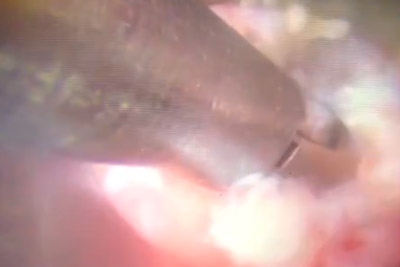
With a special vaporizer, with a laser tip that works with radiofrequency, we cauterize or retract the tissues according to needs. This vaporizer helps us identify the structures that we must clean.

Removal of the herniated disc in the lumbar area

This cleaning process with the vaporizer is very important to carry out both in the lower part and in the upper part of the posterior ligament, where the hernia is located in this specific case.

Cleaning the lower and posterior part of the ligament

We proceed to remove the hernia very slowly and very delicately so that no fragment comes loose and comes out whole. Since it is such a large fragment, the camera is removed at the same time as the hernia.

Endoscopic view of neurological tissue after hernia removal

After removing the hernia, we access the other side of the hernia to check that there are no fragments left and clean the entire canal on both the right and left sides, through which we have accessed.

Cleaning both sides of the vertebra

In the endoscopic view we see the neurological tissue in the upper part and we can verify the gap left by the hernia and that now said neurological tissue has the correct space and is completely freed.

Cauterization of the blood vessels attached to the herniated disc fragment

We cauterize the small blood vessels surrounding the extracted fragment and check again that there are no more fragments to extract and that the spacing of the neurological structures is now correct.

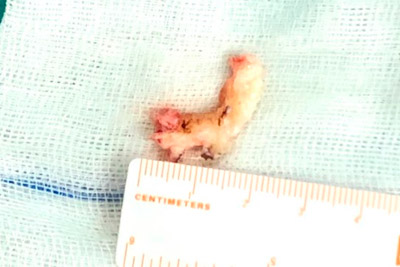
9. Herniated disc of about 2cm removed during the operation

Finally, an infiltration with local corticosteroids is performed on the patient and we wait until the effect of the anesthesia wears off to check his condition and improvement. In the image we can see the extracted hernia fragment of almost 2cm that was pressing on the canal.

Postoperative advanced spinal endoscopy

The ultra-minimally invasive technique developed by the Institute of Advanced Spine Surgery This method allows for a surprisingly fast recovery. Patients can walk away after just a few hours of surgery, experiencing minimal discomfort and with a small scar of just a couple of centimetres. This innovative method not only speeds up recovery, but also minimises the risk of post-operative complications, which become practically residual. After awakening from the anaesthesia used during surgery, the patient is discharged to continue their recovery at home. During the first week, the process of adaptation to daily routine is gradual, achieving full recovery in a short time. Generally, after about a month and a half, the patient can resume normal physical activity.

Traumatology clinic in Madrid for spinal canal stenosis surgery

In Elgeadi Traumatology, we are one Clinic specializing in advanced spinal endoscopy in MadridWe have established ourselves as a first-class reference thanks to our commitment to medical excellence and our constant commitment to innovation in minimally invasive techniques. Our focus is on offering effective solutions that not only reduce hospital stays, but also facilitate a faster and more comfortable recovery for our patients. We have a team of highly specialized trauma surgeons, dedicated to improving the quality of life of those who trust us. If you are looking for a clinic to perform spinal surgery, such as spinal stenosis treatment, do not hesitate to trust the Elgeadi Traumatology team to receive the highest quality and professional care.

Leave a Comment

At Elgeadi Traumatología we are committed to our community and open to advise and answer any question whenever possible.

To offer an accurate diagnosis to the patient, a personalized evaluation and a thorough review of their medical history will always be necessary. Once the case has been studied individually, the most appropriate treatment will be recommended to the patient according to their pathology and/or illness.

Furthermore, at Elgeadi Traumatology, we would like to remind you that no medication will be prescribed without prior consultation.

en_US
Every day closer to you

New centers

Elgeadi Traumatology

New openings in Guadalix and Rivas-Vaciamadrid, access our map of locations in the community of Madrid for more information.