


Problems and diseases affecting the hands can significantly affect the quality of life of those affected. Regardless of age or the type of activity a person performs, the hands are responsible for multiple functions that are vital to our daily routines.
Among the most frequent pathologies that one can go through throughout one's life in the hands are: wrist synovitis, rhizarthrosis, trigger finger or carpal tunnel syndrome, among other.
In this article we will address the contracture or Dupuytren's disease, a chronic disease that affects the tendons of the hand, exploring its symptoms, causes, and treatments.
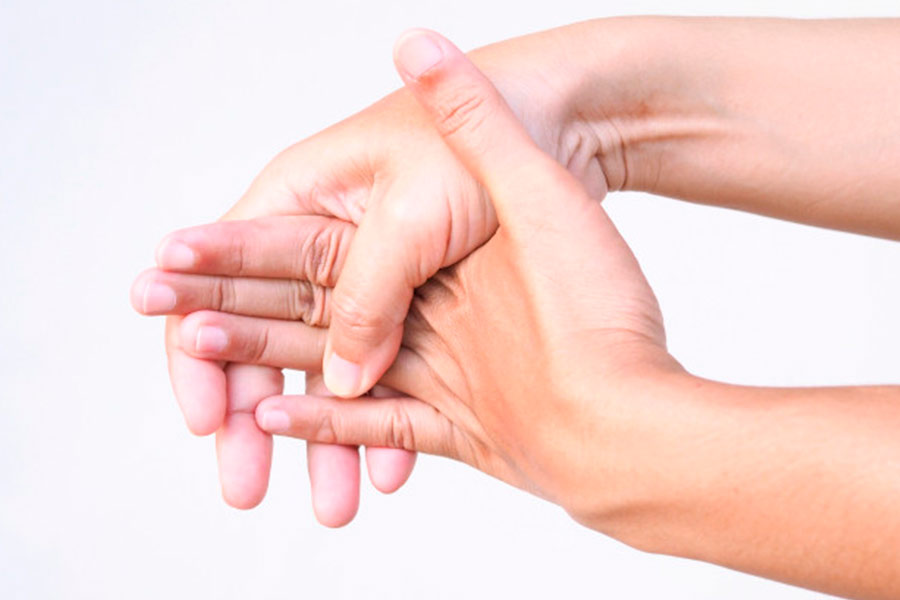
What is Dupuytren's disease?
Dupuytren's disease is characterized by thickening of the tissue located beneath the skin in the palm of the hand. This thickening produces a progressive and involuntary flexion of the fingers towards the palm of the hand.
It usually affects both hands, but in right-handed people, it begins on the right hand. This condition typically begins to manifest in the ring finger, followed by the pinky, middle, and index fingers. As the disease progresses, the patient loses the ability to stretch and flex their fingers, limiting the performance of normal daily tasks and activities.
Symptoms of Dupuytren's contracture
In most cases, The symptoms of this disease usually progress painlessly.Its first signs usually manifest as difficulties with hand mobility and palpable and visible deformities, the intensity of which varies depending on the stage of the disease.
This chronic hand disease It progresses gradually, presenting different levels of severity as it progresses.
Phases of Dupuytren's disease
As the condition progresses gradually, we encounter different stages depending on the severity of the symptoms and the degree of impairment in hand mobility. These include:
- Initial stage: Before the fingers begin to flex, the tissue beneath the skin begins to thicken and form. nodules which can be felt when touching the affected area. At this stage, pain may also appear small indentations in the palm and a thickening on the knuckles of the hand.
- Development stage: As the disease progresses, the bumps can be felt with greater determination, it is even possible to begin to firmly notice the cord of thickened tissue that passes through the palm of the hand and which produces the subsequent retraction or shrinkage of the joint.
- Advanced stage: in its most advanced phase the fingers begin to flex involuntarily, making hand function difficult. At this point, surgery becomes necessary to free the joints and improve the patient's quality of life.

What causes Dupuytren's disease?
To date, there are no conclusive studies determining the exact cause of Dupuytren's disease. Nor has it been proven that Dupuytren's contracture is related to hand injuries or harmful activities. However, some studies have been detected. risk factors presented by patients with Dupuytren's disease.
Patients with risk factors for Dupuytren's contractures
As explained, although the exact origin of Dupuytren's disease is not known, some factors have been observed that may increase the likelihood of developing it:
- Age: It is usually more common in people over 50 years of age.
- Family history: The disease usually occurs in people with affected family members.
- Ancestry: It occurs most frequently in populations of Nordic origin.
- Diabetes: A higher incidence has been detected in patients suffering from diabetes.
- Tobacco and alcohol consumption: It has been observed that these habits can promote the development and progression of the disease.
Diagnosis of Dupuytren's disease
In order to obtain a diagnosis, the patient must initially make an appointment with a specialized traumatologist. Once the patient goes to the specialist traumatologist manifesting symptoms of Dupuytren's disease, an initial physical assessment is usually performed. In it, the patient must perform different movements, with the aim of knowing whether or not there is pain.
In the most severe cases or in those where it is suspected that the disease may be caused by another pathology, the specialist may request studies such as a radiography that allows observing the bone structure of the hand, as well as possible alterations in it.
Treatment for Dupuytren's disease
Today there are surgical techniques to treat Dupuytren's disease that are very effective and have a very good and rapid rehabilitation in the patient.
A traumatologist specialist in hand arthroscopy He will evaluate the clinical condition presented by the affected person and based on his experience, he will recommend the best treatment among the following:
Needle treatment to treat Dupuytren's disease
Needle treatment is usually used when mild symptoms occur. It consists of using a needle to separate the thickened cords that have developed in the palm of the hand.
Conventional open surgery to remove tissue from the hand
In more severe cases, open surgery may be performed to remove the thickened tissue and free the joint. Unlike needle treatment, open surgery involves longer rehabilitation for the patient.
Hand arthroscopy to treat Dupuytren's disease
The minimally invasive surgery in hand and wrist arthroscopy is the most advanced technique that exists today for the treatment of Dupuytren's disease.
Because it's minimally invasive, it's recommended for both mild and severe cases. It's also a technique that offers countless advantages over other treatments.

When should Dupuytren's surgery be performed?
Surgery is usually recommended for Dupuytren's disease when the contracture significantly limits hand function. Surgery is usually not necessary in the early stages of the disease, but it is when the condition prevents you from performing everyday tasks, such as holding objects, writing, or placing your hand flat on a surface.
One of the most commonly used criteria for indicating surgery is the table test. If the patient cannot fully support the palm of the hand on a table due to finger contracture, surgery is likely necessary.
The decision to undergo surgery should always be made in consultation with a specialist, who will assess the degree of involvement and discuss the benefits of the procedure compared to other conservative treatments.
Advantages of minimally invasive surgery for Dupuytren's disease
As we have mentioned, minimally invasive surgery offers multiple advantages for the patient, including:
- Risk reduction: Since it is a minimally invasive technique, the chances of infection, bleeding and damage to surrounding tissues are significantly reduced.
- Better aesthetic result: The procedure is performed with very small incisions, generally less than 5 millimeters, which minimizes scarring and improves the appearance of the hand.
- Faster recovery: The postoperative period of minimally invasive surgeries is usually less painful and allows for faster rehabilitation compared to conventional surgery.
Exercises for Dupuytren's disease
Whether conservative treatment is recommended or after surgery, your doctor may prescribe a physical therapy program with exercises designed to maintain hand mobility and delay the progression of the contracture.
While these exercises do not reverse the disease, they do They help improve finger flexibility and reduce stiffness. Among the Most recommended exercises for Dupuytren's contracture These include finger stretches, passive flexion and extension, the use of a soft ball, and joint mobility massages.
It's essential to perform them regularly and painlessly. In advanced cases, a physical therapist can design a program tailored to each patient's specific needs.
Traumatology clinic for minimally invasive surgery in Madrid
When minimally invasive surgery is necessary to treat trauma pathologies, it is essential to go to specialized doctors who have the necessary experience and knowledge to guarantee the best results.
He Professor Doctor Elgeadi's team has International recognition in minimally invasive techniques, being one of the main references at the national level to develop arthroscopic hand and wrist surgeriesThis is thanks to their team of trauma specialists in hand and wrist arthroscopy and arthroplasty in Madrid.
If you're looking for a specialized team to treat your condition, don't hesitate to schedule an appointment at our center. Our team can support you throughout your recovery so you can regain your quality of life as quickly as possible.


27 thoughts on “Enfermedad de Dupuytren: síntomas, diagnóstico y tratamiento”
I have had surgery for a Dupuytren's on the left hand of the little finger and the one next to it.
At the last visit the doctor told me that it had become reflex dystrophic syndrome.
At the rehabilitation center where I attend, they do magnetic treatment, they give me infrared or laser, ultrasound and currents. At home I do hot and cold water sessions (3 minutes, 1 minute. Three times. And at two or three different times of the day.)
What exercises (movements) are good to do at home to recover? And which ones are contraindicated, if any?
Thank you so much
Jordi
Hello, Jordi!
We are happy to know that your recovery is satisfactory. It is best that the specialist who is treating you prescribes the rehabilitation exercises. If you want you can write to us at our email [email protected] where we can give you guidelines for correct evolution.
All the best!
Hello. I have had left hand Dupuytren surgery. Little finger on the side and thumb. It has been in operation for 3 months. But I will have about 25 rehabilitation sessions. I still haven't closed my hand and my little finger and they are like stone on the side. I'm a little worried. It is normal?
Hi Carlos!
Recovery may vary for each patient. Discuss your symptoms with the specialist who is scheduling your rehabilitation because it may be necessary to perform other types of exercises. If you have any questions, write to our email [email protected]
All the best!
Hello, I have had 3 surgeries on my hand due to Dupuytren, 1 time a year, the last one is being operated on with a skin graft because the skin on the palm could not be saved, leaving the middle finger without surgery and today, 4 months later, the index finger shrank and engross I visited other hand specialists who told me that the chances of recovering the finger are very poor since it is too early for another surgery and if they do not operate they could amputate my finger since it is turning a black-purple color. Please help
Hello, María Eugenia!
Thanks for your comment. Write to our email [email protected] providing us with complete information and we will try to give you the best solution,
All the best!
I recommend that you make an appointment with Dr. Piñal and associates in Madrid.
He operated on me, performing a second skin graft.
Good afternoon.
My brother has both hands severely affected by Dupuytren's as well as after-effects from a stroke.
Social security has told him that some fingers would have to be operated on and others amputated, that there used to be some injections that would be very suitable for him but that no longer exist.
Today only surgery is possible?
I would appreciate your advice.
Thank you
Good morning,
We are very sorry for your illness. In your case, we cannot give you a specific answer. First of all, it will be necessary to make a medical diagnosis and then offer you the most appropriate treatment. Therefore, we recommend that you make an appointment with our traumatology specialists, or you can also do it by phone.
All the best.
Hi, I'm an angel. Ami, I had surgery. It was on the palms of my hands. It's been 7 years now and I'm still feeling bad. My hands go numb and they swell. Oh, there's a lot of pain, what can I do?
Good morning angel,
Thank you very much for commenting on our blog. We are sorry for the situation you are in. In your case, the right thing to do is to consult with a trusted traumatologist so that he or she can carry out a complete study of your symptoms and determine the most appropriate treatment. You can contact our team of expert traumatologists at the following link: https://elgeaditraumatologia.com/contacto/
All the best.
Hello! A family member fell and had surgery on his broken wrist. Before this, his hand was fine, but when the cast is removed and rehabilitation begins, his little and ring fingers are shrunken. They have told her that she has this Dupuytren's disease and that they have to operate again.
My question is... If he was fine before the operation, wouldn't it be a medical failure, either due to the cast or the operation?
Is this possible? thank you so much
Good afternoon Ana,
Thanks for your comment. We regret that we cannot offer you an exact diagnosis, since the case would have to be studied in depth. You can request an appointment with our trauma team If you wish, where the necessary medical studies will be carried out.
All the best.
I am a hairdresser, and my fingers fall asleep and twist horribly with a lot of pain, must I have that disease!!
I'm terrified of this, can you help me what should I do?
Good morning Mirian,
In order to offer you a complete diagnosis, it would be necessary for you to come to our trauma clinic, where we can evaluate the affected area.
All the best.
Greetings Friends, my name is Dimas and I have Dupuytren's disease. Until now I am looking for help or a hand specialist since the disease is advancing considerably and is affecting my hands.
Good morning Dimas,
We are very sorry for your condition.
He trauma team from Elgeadi Traumatology can help you. First it would be necessary to study the affected area carefully, and then offer you the most appropriate treatment.
All the best.
Good afternoon; My name is Rossana, I was diagnosed with Dupuytren's disease, ring finger on my left hand, I am an insulin-dependent diabetic, I noticed the bulge in my palm in February of this year, and the volume has been growing, so I consulted because it continually worries me. growing, however I have no pain and the fingers do not show difficulty moving although the middle finger already has an inflammation detected today when I had an ultrasound. I don't know if they will indicate surgery or another treatment since they told me about one that was based on an injection with corticosteroids and another component that would destroy or dissolve the tissue...if surgery is the best option, what specialty should the traumatologist have??? ???….
Thank you.
Hello Rossana,
The treatment of Dupuytren's disease must always be carried out by a traumatologist specializing in the upper limb unit. My recommendation is that you come to our consultations so that we can evaluate you and see which is the most appropriate therapeutic option. The origin of the lumps can be multiple, it does not always have to be attributed to Dupuytren's disease.
A hug.
The fingers of my hand bend forward without any pain and it is very difficult for me to stretch them, this happens to me when I use my hands a lot, this has already happened to me many times, it is like a cramp without pain, but this last time it cost more, which My fingers returned to their place, I'm worried.
Hello, Elizabeth,
From what you tell us, it doesn't seem like it's Dupuytren's disease. It could have multiple causes. The analysis would have to be evaluated, the electromyography evaluated and to see if there are neurological lesions. In your case, it will be necessary to review the evidence thoroughly.
Greetings.
Hello, I'm Dei. At night I start to feel pain in the fingers of both hands. I have trouble moving them or bending them. I don't notice any serious deformity, but I do notice that when I wake up my hand is always closed and I have trouble stretching my fingers. I try to exercise each one with pain and that way they return to normal and I spend the rest of the day without pain. However, lately I have noticed that during the day they hurt a little and I have trouble opening things or grabbing things. I feel like I have lost strength.
On the other hand, I've been considering that I might have something to do with my nails, since I go to the manicurist every month and use products like polygel and a nail polish drying lamp, and I've been doing my nails this way for many years.
I'm kind of addicted to having my hands manicured and my nails painted.
The thing is, I'm getting really scared thinking that one day I might end up with disabled hands and that would be so bad that I can't even imagine being able to live without hands.
Hello Dei,
What you describe—pain and stiffness in the fingers, difficulty opening the hands, and loss of strength—requires evaluation by a hand trauma specialist, as it may be related to a joint, tendon, or nerve condition in its early stages.
It's also worth considering prolonged use of products like polygel and frequent exposure to UV lamps, as these can contribute to irritation or sensitivity in some people, although they are not usually the primary cause.
We recommend that you don't postpone a medical consultation, as an early diagnosis allows you to effectively address the problem and prevent it from progressing.
If you wish, you can make an appointment at our center so one of our team of orthopedic surgeons can assess your case individually. We'd be happy to help you.
Good luck and thank you for trusting us.
Hello, I had Dupuytren's surgery on my right hand on October 24th and on my left hand on January 25th. I had stiffness, pain and numbness in both hands. I have had 30 rehabilitation sessions and I don't see any improvement. In addition, the disease is affecting all the phalanges in both hands. It is progressing and it limits me from carrying out my daily tasks as I have lost strength. It is desperate. The mutual insurance company has told me that it will be difficult for me to return to work, as I am on a production line in the automotive sector.
Hello Jose,
Thank you for sharing your experience. We understand how frustrating and worrying it can be to deal with a condition like Dupuytren's, especially when pain, stiffness, and loss of strength persist despite surgery and numerous rehabilitation sessions.
When the patient's progress is unfavorable and symptoms limit both daily activities and the ability to continue working, it is essential that a multidisciplinary medical team (orthotomy, rehabilitation, rheumatology, among others) thoroughly review your case. In some cases, additional treatments may be considered, such as specific injections, complementary surgery, or even the possibility of adapting your job, if feasible.
To better guide you, we would need to evaluate your current medical records and your progress since the procedures. If you wish, you can schedule an appointment with our specialists, and we will be happy to help you explore new options or, at the very least, provide a clear assessment of your current situation.
Greetings.
Hi, I just found out I have Dupuytren's contracture and I'm terrified.
I read everything all day long, and my fingers are still fine, but there's a lump in the palm of my hand and it's starting to hurt a bit. And I don't know what's coming.
I want to ask if any doctor
If I wear a splint to keep my right fingers longer... Oh my God, tell me something. What can I do against this monster that awaits me?
Hi Fina. We completely understand your concern; receiving a new diagnosis can cause a lot of anxiety, but Dupuytren's disease usually progresses slowly and in many cases can be controlled without the need for immediate surgery.
Splints or specific exercises can help maintain finger mobility for longer, although it is important that a specialist in hand surgery or traumatology assess your specific case before using any device.
We have some of the best specialists in the country and internationally, who can advise you on the most appropriate treatment for your situation. If you wish, you can make an appointment by calling 91 005 39 00.
Hang in there, Fina. With medical follow-up and proper care, it's possible to maintain a good quality of life.
Greetings