


Trochanteritis or pain syndrome of the greater trochanter appears as a set of pain symptoms that are located on the lateral aspect of the hip. It is a pathology that affects 10-20% of the population, occurring in patients between 40-60 years old, especially women. In this post we delve into the causes, symptoms and treatment of trochanteric bursitis.

What is the greater trochanter?
The greater trochanter is a bony protuberance located on the top of the femur.. It is composed of an external profile, which has a rough area called the relief of the gluteus medius. The other profile, located internally, contains the digital fossa, in which the external shutter is anchored.
Function of the greater trochanter
The greater trochanter is the point of origin of various muscles that make up the human body, in addition to being involved in maintaining the stability of the lower limb. Therefore, it is possible to perform certain movements that involve the hip, such as walking and running.
Injuries affecting the greater trochanter
The most common pathology in the hip that specifically affects and alters the greater trochanter It is what is known as trochanteric bursitis or trochanteritis, a process of inflammation of the structure of the bursa appearing.
Cases of hip bursitis also tend to be one of the most frequent pathologies that appear in the hip region, since certain movements such as walking or running cause irritation of the bursa.
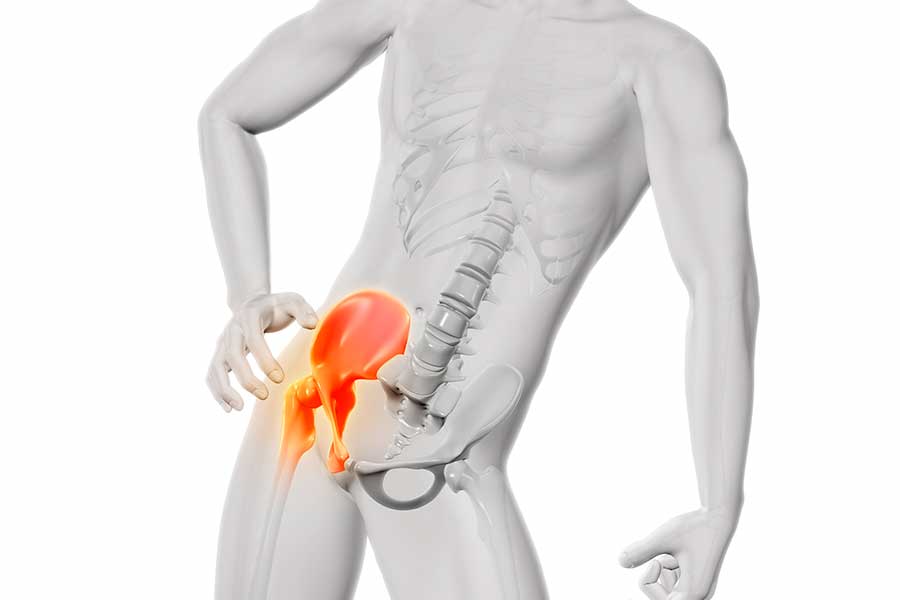
What is trochanteritis?
Trochanteriris, also known as trochanteric bursitis or greater trochanteric pain syndrome (GTPS) appears with inflammation of the greater trochanter of the femur and the bursa that protects it, thus causing a joint spill of synovial fluid and pain in the hip.
It is an inflammation caused mainly by overuse of the hip joint or performing repetitive movements. Furthermore, it is a pathology that generally affects people between the ages of 40-60 and it is estimated that between 10 and 20% of the population suffer from this condition at some point.
Causes of trochanteric bursitis
As previously indicated, trochanteric bursitis is caused by the continuous friction generated by hip flexion-extension movements, which are called repetitive microtrauma. Additionally, some of the most frequent causes are:
- The practice of sports. Trochanteric bursitis usually appears in marathon runners or soccer goalkeepers, since they are sports that involve excessive friction in this region.
- Biomechanics of the legs. When there is a discrepancy in the length of the legs since childhood, it generates an alteration in gait and inflammation of the bursa.
- Certain cases of trochanteritis can be observed in patients who have a certain degree of obesity, which generates overload in the lower joints.
- Trauma caused by falls and direct blows can result in inflammation of the greater trochanter.
- Presence of osteophytes or calcium deposits in the tendons that adhere to the greater trochanter.
- Poor posture, which can be caused by scoliosis, arthritis of the lumbar spine, and other spinal disorders.

Symptoms of trochanteritis
He characteristic symptom of trochanteritis is the pain in the hip, normally located on the outer part of the thigh. Initially, when this injury appears, the pain is intense and acute, while over time, the pain intensifies when performing tension movements of the bursa, such as abduction and rotation movements of the hip.
When lying on your side on the hip and the affected area, this pain intensifies. In extreme cases, the pain is associated with tingling sensations that radiate down the outer thigh to the knee.
How is trochanterosis diagnosed?
The diagnosis of trochanteric bursitis is fundamentally clinical. The first criteria for a diagnosis of trochanteritis are based on complementary tests. Using an x-ray, microcalcifications can be detected over the trochanteric area.
In acute cases, the volume of the enlarged bursa can be observed using ultrasound. On the other hand, computed tomography (CT) allows us to object to bone alterations and perilesional calcareous deposits.
Treatment for trochanteritis in Madrid
The treatment of trochanteritis is usually, first of all, conservative, for less severe cases. By taking anti-inflammatory medications, it is possible to reduce pain in the region and improve the patient's mobility. On the other hand, it is recommended to practice exercises that have a low impact and help strengthen the area.
In cases where conservative treatment does not work and the pathology has worsened over time, it is necessary to opt for surgical treatment. The Elgeadi Traumatology team is hip arthroscopy specialist. Through small incisions in the patient's skin, the hip joint can be observed to observe the disease.
At Elgeadi Traumatology we are specialized in the most advanced minimally invasive surgery techniques. Thus, if you detect any of the aforementioned symptoms of trochanteritis, do not hesitate to make an appointment with our team of expert hip traumatologists to receive a diagnosis and begin the most appropriate treatment.


56 thoughts on “Trocanteritis: qué es, causas, síntomas, diagnóstico y tratamiento”
Thank you, the information is very clear, my pain is exactly in that place, it affects my leg, knee and femur bone… I will see what my doc says.
Good morning Jeanette,
Thank you very much for your comment.
You can request an appointment with our Madrid traumatologists if you wish.
All the best.
All the best.
J ai justement ce problème, que me conseiller vous?
Hello, I am a doctor and I have been struggling with this for a few years now. I have a very pronounced right trochanteritis with gluteus medius insufficiency and tendon calcifications. I had my hope pinned on the infiltration of stem cells, but the rehabilitation doctor who took me denied it because the hospital, due to financial problems, had prohibited them. Could you tell me something about it? I am desperate not only because of the constant pain but also because of functional impotence.
Thank you
Hello Angeles,
A priori, the ideal would be to perform functional RHB to gain the gluteus medius. Instead, try to perform infiltrations with biological therapy before the stem cells.
A hug.
It happens to me exactly as you explain, in the head of the femur and it radiates to the gluteus, and the calf with the foot, very strong cramps every day, I hope it heals, I only take paracetamol, it is a lot of pain and it invalidates you, I hope I can only go away with paracetamol. I've been like this for 2 months now.
Hello manuela,
It is not good to take medication for so long in a row.
We recommend that you do rehabilitation with a physical therapist.
Greetings.
Good afternoon.
Excellent and clarifying article. I've been doing rehabilitation and anti-inflammatory medication and gluteal strengthening exercises for three months and I'm not getting any better. I am a Physical Education teacher and although I have been on sick leave since then, I feel highly frustrated due to my functional impotence. Is infiltration recommended in these cases? How long can a crisis of this type last? Is neuromudulation useful?
Thank you.
Hi Patricia,
Yes. The need for infiltration could be evaluated. Neuromodulation treatment along with manual therapy and some other techniques that your physical therapist may recommend, such as high-power laser, can help your recovery.
Greetings
Good afternoon
It's been a little over a year since I started having this pain in my left trochanter right after a hysterectomy.
I can do everything except walk. I am currently doing aqua gymnastics. But the pain continues. I am 53 years old..
Ah All the information and comments have been very useful. Regards, Verónica from Argentina
Bonjour j'ai also these douleurs apparu apres une ovariectomie, l'échographie ne montre aucun problème j'attends donc l'irm car cela devient compliqué de vivre avec this douleur
Bonjour Celine. A persistent pain after an ovariectomy, failure of a normal ultrasound, may be caused by nerve irritation, adhesion or a musculoskeletal cause. L'IRM aidera à préciser l'origine and à orienter un traitement adapted pour vous soulager.
I have been in intense pain for months and walking with difficulty. I have had some relief with anti-inflammatories, but a few days ago I started with ice for 20 minutes twice a day or whatever I can and my improvement has been notable. I only have a little limitation when climbing stairs. I also started wearing comfortable shoes but not flat ones.
Good morning, my daughter was affected in July of last year, from the right thigh on the 6th side down to the foot, three toes are asleep, the sole of the foot, the heel, with anti-inflammatories, pain, walking with cramps, the pain went away but I had to walk with a cramp, it is the right one with a prosthesis for 11 years but now it has been a month since I was diagnosed, I am all swollen, I cannot walk, I live alone and I have pain that I have to do it, scream, cry, this is unbearable yet, I am waiting for trauma and to have my spine checked, everything that has been done in the emergency room and I am 74 and I have Frimomyalgia and I am with it now this is going to be cured or something like that, always in pain because I am depressed and anxious.
Hello M. Isabel,
We are very sorry about the situation you are going through. It is important that you stay in contact with your trauma specialist so that they can thoroughly evaluate your case, especially if the symptoms have worsened. Since you mention inflammation, intense pain and difficulty moving, it would be advisable for you to consult as soon as possible to adjust the treatment and rule out other causes related to the spine or the prosthesis.
If pain and anxiety are affecting your quality of life, you may also want to consider medical support for chronic pain management and emotional health. We hope you find relief soon.
Greetings.
Hello, I'm Fernanda, I've been here for years. I have this pain, but it gets stronger every day. I have had infiltrations. I have taken many anti-inflammatories and now it is difficult for me to walk because of the pain. I don't know what else to do.
Very good morning Fernada,
When conservative treatment does not work, it is necessary to evaluate the possibility of performing an intervention to solve the problem.
We would have to look at the tests to determine if arthroscopic hip surgery can improve your pathology.
Greetings
I am Vivian, I have calcifications in the right anterior rectus with a lot of pain. Shock waves and massages relieve it but it reappears. Now left trochanteriris. Siho exercising although with pain. They sent me rpg. They recommend another alternative. Thank you, I am from Santa Fe Argentina
Hello Viviana,
To give you any medical recommendation we would need to know your case and see your medical history. In principle, the steps you are following are on the right track.
Greetings
Bonjours
Je souffre after 3 mois du bas du two de la hanche et de la cuisse gauche au mois de janvier on m'a dit que c était un lumbago soigné par kinésithérapeute et zaldiar qui me donner la nausée donc arrêté, ensuite au mois de février on m'a dit que c était une siatique soigné par injection de voltaren par l infirmière sa m'a soulagé pendant au moins 15 jours et sa recommence…ici échographie effectué et voilà décelé trochanterite avec calcification des tandon des muscles de la hanche voilà reparti pour de la kinésithérapeute et des injection de voltaren j espère que sa ira mieux car déjà 3 jours d.injection et encore plus mal
Bonjour Laurence,
See our contacts at cliquant ici pour demander un rendez-vous et traiter votre cas en privé.
Greetings
Bonjour je m'appelle Patricia… descendant de l'avion il ya 9 mois j'ai eu mal à la hanche. I do not need to take any more medications within 11 days. Et rien tjs mal J'ai fait de la kiné de l'acupuncture des ventouses Je suis ex prof d'éducation physique j'ai 69 ans … C'est horrible je sais presque plus marcher .Heureusement je sais encore nager. Avec ça j'ai grossit vu que je reste le plus souvent ds mon fauteuil…je n'en peu plus
Bonjour Avenel,
See our contacts at cliquant ici pour demander un rendez-vous et traiter votre cas en privé.
Greetings
Bonjour, je prénomme Eve
Voici presque 3 years que je traine this horrible douleur du côté droit (hanche et jambe).
Today, a premiere infiltration in the vertebral colon brought me a soulage of my quelques. A deuxième infiltration fut sans succès. Prochainement, je dois upload une péridurale lombaire qui devrait me soulager. ??? J'ai beau expliquer que j'ai mal à la hanche et à l'extérieur de la cuisse …que je ne sais presque plus marcher. Les médecins s'obstine à traiter ma colonne vertébrale…..ont ils raison??? J'ai 72 ans, je suis très volontaire et je n'accepte pas ma situation.
Merci de m'éclairer et merci pour vos explications qui m'ont été d'un grand réconfort.
Bonjour Eva,
See our contacts at cliquant ici pour demander un rendez-vous et traiter votre cas en privé.
Greetings
Hello. For some time now I have been experiencing pain in the head of my femur when I lie down. Your explanation has been very helpful. I also have pain in my groin, on the inside of my leg, and I am almost unable to put weight on my foot and walk. The pain is similar to trochanteritis. My diagnosis is hip osteoarthritis.
Hi Silvia, thanks for sharing your situation.
The symptoms you describe, such as pain in the femoral head, groin, and difficulty bearing weight on your foot, are common with hip osteoarthritis. Trochanteritis can cause similar pain, but given your diagnosis of hip osteoarthritis, it is important to consult with your doctor to evaluate the best treatment and pain management option, which may include physical therapy, medications, or in some cases, surgery.
Greetings
Good afternoon, I have had a pelvic MRI and they have told me that I have trochanteritis, but my hip does not hurt, my groin hurts a lot and the pain goes down the front and outer side of my thigh….so I don’t know if it is this or something else and what other tests could they do? Thank you, it hurts quite a bit when I walk, go up stairs, bend over and get up, but when I sleep in bed it hurts a lot more….please can you help me…
Hello Incarnation,
Although trochanteritis usually causes pain in the hip, pain that travels down the thigh and groin could be related to another condition, such as spinal or nerve problems. We suggest you request further evaluation, such as an MRI of the lumbar spine or neurological studies, to rule out other causes.
Greetings
Bonjour
Mon fils a eu un rhume de hanche bilateral a l age de 8 ans avec présence de liquide
The hospital decided not to remove the water.
About 3 weeks after radio plus water.
Pendant 2 years from 8 to 10 years until the last one is left
We are failing our exams.
The douleur is situated on the level of the 2-côtés illiaques.
Irm radio bilan on our dit tendinopathie chronique bilatérale des tendons illiaques dues à une forte croissance.
Il avait pris 14 cm en 12 mois.
Kine ondes de chocs balnéothérapie ostéopathes rhumatologue etc etc
No result.
On our shipment to the center anti douleur on lui prescrit de la morphine et encore de la kine.
La morphine makes you sleep 24/24.
Apart from the inflammation of the illiaque tendons, the rest is visible in both examinations.
We don't know what else to do
Thank you
Bonjour je souffre d'un syndrome douloureux du grand croquentaire – j'habite bruxelles en belgique – avez vous un médecin ou hopital se trouvant en belgique qui pourrait m'aider sur ses douleurs atroces qui me transperce la hanche et la jambe droite
Thank you
maryke vandenabeele
Hello Maryke,
Nous sommes désolés d'apprendre que vous souffrez de ces douleurs. If you find out, you can effect a video consultation with our specialists, who will evaluate your pathology and work on the treatment appropriate to your situation.
To obtain more information on how to proceed, you can write to it. [email protected].
Greetings.
Good morning, I'm Ana Mari, I'm 64 years old and I have pain at the level of the trochanters, it radiates to the right area of both
thighs and knees. After a week of anti-inflammatories, I haven't improved, and I'm still in pain when I climb stairs and get up from a chair. My doctor sent me for rehabilitation.
I would appreciate some advice on how to improve.
Thank you so much
Hello Ana Maria,
It's a good thing your doctor has prescribed rehabilitation, as it can help improve mobility and reduce pain. In the meantime, you could apply local heat or cold as tolerated and avoid movements that could aggravate the discomfort. If the pain persists or limits your daily activities, a specialist evaluation would be recommended to adjust your treatment.
Greetings.
I am blocked from the waist down in the lumbar area, I have protrusions, osteoarthritis, bulging and I also have spondylosis, as a result of this, although I still have some pain in my lumbar region but it is more bearable, I have a burning pain in my right thigh that prevents me from even putting on clothes because it is uncomfortable to the touch, I am seeing a physiotherapist and doing exercises at home! They are going to do an electrocardiogram and an ultrasound hoping they find a solution since I have been there since November!! Any advice or what could this sensation in my leg be about?
Hello Mari Carmen,
Thank you for sharing your case. What you're describing about your leg could be related to nerve compression, something that can occur in conditions like the one you describe. It's very positive that you're receiving physical therapy and getting tests done, as with those results, an orthopedic surgeon will be able to more accurately assess what's happening and recommend a treatment that will help alleviate your discomfort.
If you wish, we can help you schedule a consultation with our team so they can evaluate your tests and determine a specific treatment.
Good luck and a speedy recovery.
Hello .
J'ai fait une chute en janvier, je suis tombée sur le côté gauche et plus moyen de marcher. J'ai 2 prothèses de hanche .
Suite à this shot, radio, (les prothèses n'ont pas bougés) scintigraphie, scanner et tout est normal.
Mais je souffre terribly and beaucoup de difficultés à marcher, je fais de la kiné, je prends des antidouleurs, anti inflammatoire et toujours ces douleurs terribles.
Finally injection of voltaren et cela me soulage un peu.
Il ya un mois, IRM qui décèle à droite Contact discoradiculaire extra-foraminall'en L4- L5 droit et intra foraminale enL5- S1 droit.
The neuro chirurgien decèle du côté gauche une tronchanterite qui me fait terribly mal., une sciatique et une tendinite.
Ce jour on m'a fait une infiltration du côté droit mais rien ne fait, je ne sais tjs pas marcher et j'ai des douleurs dans le mollet gauche également. Que dois je faire, je suis désespérée, à mon avis la kiné ne sert à rien. Can I use the laser for the trochanterite? Merci de me lire et de me conseiller.
Hello,
It is important to provide your medical advice and assure that all treatment options are well-priced. Même si la kinésithérapie est essentielle pour la récupération, je comprends votre frustration si vous ne constatez pas d'amélioration immédiate.
Concerning the laser, there are laser treatments that have high power that are used for affections such as trochanterite, and that can help reduce inflammation and pain. Toutefois, l'ideal serait qu'un spécialiste évalue votre cas pour déterminer si ce type de traitement est adaptedé à votre situation.
If you receive a second notice, we are specialists in evaluating your personal situation. You can take a look at our clinic, and we will help you find an approche that will provide you with soul care.
Nous vous souhaitons un bon rétablissement et beaucoup de courage dans ce processus.
Hello, I have bursitis on my left side because I fell two years ago and it still hurts. When I exercise, like jumping on a trampoline, it gets better. I don't take anything, and the pain came back. Is there a cure? Or will it never heal?
Hello Maria, thank you very much for your message.
Bursitis, especially if it started after a fall, can become persistent if it hasn't received proper treatment from the start. Even if the pain has lessened at times, such as during moderate exercise, if it recurs, it's a sign that there may be chronic inflammation or ongoing irritation in the area.
In most cases, bursitis is treatable and can significantly improve, or even resolve completely. It's best to conduct a clinical evaluation to confirm whether the bursitis is still active and, based on that, consider options such as physical therapy, specific exercises, anti-inflammatory treatment, or other techniques, as appropriate.
In order to provide an accurate diagnosis and determine the most appropriate approach, it would be necessary for one of our specialists to evaluate the injury in consultation.
Greetings.
Bonjour
Je m'appelle Monique depuis plusieurs années je souffre de bursite trochanterienne.
J'ai fait kiné infiltration tens.
Je courrais beaucoup.j'ai dû arrêter.
On veut me donner du laroxyl seulement c'est un cache misère je ne sais plus que faire.
Merci de vos conseils
Hello Monique,
Merci beaucoup d'avoir partagé votre cas. La bursite trochantérienne peut être persistent. In certain cases, in addition to kinésithérapie et des infiltrations, there are other treatments that are useful.
Pour pouvoir vous recommander l'option la plus adaptée il serait nécessaire d'évaluar votre situation de manière personnalisée et de revoir vos exams. Si vous le souhaitez vous pouvez prendre rendez-vous avec notre équipe et nous serons ravis d'évaluer votre cas afin de trouver le traitement le most efficace.
Greetings.
Bonjour
Bien reçu votre message.
J'habite en France à Rennes.
Dernièrement mon kiné me dit que c'est plutôt de l'arthrose. After the scanner is discrete arthrosis.
But it is true that it is plus the most amplitude. La bursite trochanterienne profonde doit toujours être là.
I don't want to sleep on the coast.
Your vacation in Denia in September will spoil the chalet and the baignade will change.
Chose that I do not understand my medicine without the antidepressants. It is horreur.
Je fais un pas en avant et deux en arrière.
This is where the exchange is open.
Best regards
Monique Cloteaux
Hello Monique,
Merci d'avoir share your experience on our blog. Nous sommes désolés d'apprendre que vous ressentez encore de la douleur malgré le traitement. La bursite trochantérienne peut être persistante et coexister avec de l'arthrose, ce qui peut rendre la récupération plus difficile.
The treatment depends on the cause and evolution of pathology. In certain cases, a physiothérapie, des infiltrations or même a chirurgical evaluation may be necessary. To determine the most suitable approach, a consultation with one of our specialists will be essential to evaluate your situation in detail.
Greetings.
Good morning, I have fibromyalgia, bilateral gonalgia and chronic trochanteritis. I am taking pregabalin. I had a leak in both hips three months ago, but my legs and groin have been in a lot of pain for over two weeks. It prevents me from walking or climbing stairs because of the pain. At night, I cannot sleep because of the pain in my legs and I cannot turn sideways because of the pain. What recommendations can you give me? What could it be?
Hello Maria Victoria,
Thank you so much for commenting. We're so sorry you're experiencing this pain. Based on what you're describing, it's important to have your case reevaluated by a doctor, as worsening symptoms despite current treatment require an in-person evaluation and possibly further testing to identify the cause and adjust treatment.
We recommend that you schedule a consultation with your specialist so they can determine if this is an evolution of fibromyalgia, an additional joint problem, or another condition.
Greetings.
Bonjour j ai une bursite du grand trochanter et tendinite du muscle gluteal du même côté. And after breaking part of the ligaments, the maintenant is already 18 months. Je ne réponds plus aux corticoide que se soit voie orale ou infiltrations.. j ai une pathologie, la polyarthrite rhumatoïde sero négative atypique qui s attaque aux entheses. Après rdv avec chirurgien orthopédiste celui acceptait de m opérer et maintenant sy refuse!! You are disant that je ne serai pas prête de remarcher! Pouvez vous me dire pourquoi car il m à laisser sans aucune réponse
Hello Isabelle,
Nous sommes vraiment désolés pour la situation que vous traversez. Pour pouvoir vous donner avis approprié, il serait nécessaire qu'un médecin de nore équipe évaluate your exams and your particular cases, in order to determine if the surgery is a viable option or not.
If you are souhaitez, you can prendre rendez-vous avec nous and nous serons ravis de vous aider et de vous orienter sur les prochaines étapes à suivre.
Greetings.
Mari Carmen called me
I would like to comment, I have had pain in my right hip for some time now and it extends to my groin and thigh.
It hurts when I walk and climb stairs, and I can't sleep on my right side because of the pain.
Could you tell me what it might be?
Thank you so much
Hello Mari Carmen, thank you for writing to us and for sharing your situation.
The pain you mention in your hip, radiating to your groin and thigh, especially if it worsens when walking, climbing stairs, or sleeping on that side, can be related to various causes, such as alterations in the hip joint, tendons, or muscles of the area.
However, without a physical examination and imaging studies, it is impossible to determine the exact origin.
We recommend that you seek a medical evaluation to obtain an accurate diagnosis and determine the most appropriate treatment to relieve pain and improve your mobility.
If you wish, you can schedule an appointment for a personalized assessment with our team by calling:
+34 91 005 39 00
We'd be happy to help you.
Best wishes, and get well soon.
Good evening, my name is Monse. I had lumbar surgery in 2020 and have plates and screws in my lower back. Before the surgery, I started experiencing unbearable pain in my groin and thighs, with sores all the way down to my feet. I get injections every six months, but they don't help anymore; my toes are numb. I'm having a very hard time. I'm taking oxycodone, gabapentin, Enantyum, and other medications.
Hi, Monse.
With a history of lumbar surgery with plates and screws, persistent pain, tingling, and lack of response to injections and medication, a specialized re-evaluation is important to study the origin of the pain and adjust the treatment.
We recommend an in-person consultation with a spine specialist.
You can contact us in Madrid at +34 910 053 900.
Hello. I had hip replacement surgery after a fall. The first few months were great. That was 10 months ago. Now I have trochanteric bursitis. I'm doing physical therapy and rehabilitation. If I don't apply ice, it gets inflamed and painful. I have trouble climbing stairs. My wound is healing well, but I feel limited. Painkillers are making me feel bad because my creatinine levels are a bit high. Thank you. .
Hi Virginia, after a hip replacement, trochanteric bursitis can appear, and if it limits and becomes inflamed despite physiotherapy, a re-evaluation is advisable to adjust rehabilitation and assess safe options for pain with elevated creatinine, avoiding anti-inflammatories if they are not suitable.
I have a wedging of the L2 vertebra from an accident years ago, without symptoms. I am an active person, and I started with tightness in my right lower back, then upon getting out of bed I experience sharp pain that prevents me from walking or standing upright, along with pain in my buttocks, groin, and lower back. This pain subsides within an hour, and I can resume my normal activities with only slight discomfort. Can you offer any guidance?
Hi Rosario, that sharp pain when you get up, radiating to the buttocks and groin, is usually consistent with a lumbar/facet joint block or localized muscle/disc irritation, rather than the old wedging. If it recurs, limits your movement, or causes tingling/weakness, a consultation with an orthopedic surgeon is recommended, and if necessary, imaging to adjust the treatment.